

I recently wrote about how today’s cyber risk is defined less by breakthrough innovation and more by the industrialization of existing weaknesses. Given this, I wanted to dig a little deeper. Over a weekend I conducted some analysis on a longitudinal Aggregate Cyber Risk Index that scores six core threat vectors daily for 1,000 days on a 0–100 scale, drawing on six macro categories: active exploitation activity, identity and trust-system risk, operational disruption potential, infrastructure and supply-chain exposure, geopolitical and strategic cyber activity and the accelerating impact of artificial intelligence (AI) on offensive capability.
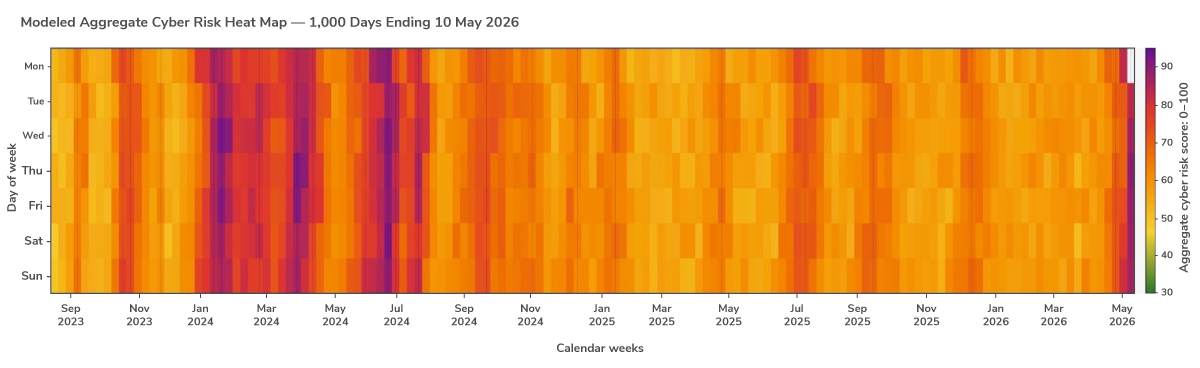
Figure 1: Modeled Aggregate Cyber Risk Heat Map
Over the last thousand days, something fundamental has shifted in the cyber threat landscape, and the data reveals a stark pattern: cyber risk doesn’t ebb and flow, it compounds. The darkest bands on our heat map aren’t isolated spikes. We see that they are clusters, each driven by the convergence of multiple threat types. In early 2024, for example, the simultaneous exploitation of identity platforms, healthcare infrastructure and cloud providers drove cyber risk to levels with no prior precedent.
The resulting index, depicted above, shows a structural, sustained escalation of cyber risk and a clear signal that we are entering a new, more dangerous phase.